
Max Hamon
Editors’ note: This week marks the final series for Borealia after a decade of online public history and conversation. You can read our thank you remarks here, and will be able to access Borealia’s back-catalogue for at least another couple years. Thanks for reading, and thanks to E.A. Heaman, Max Hamon, and Jerry Bannister for this final series, bringing historical perspective to this current moment of nationalism redux and cross-border complexity.
It seems rather difficult to make sense of the postures about American international relations these days. History doesn’t offer any real lessons, but recalling previous border tensions might help give us some perspective on how Canada and the United States have charted their relationship.
The basic outline of the Cypress Hills Massacre should be relatively well-known to many readers of Borealia. In the late spring summer of 1873, a band of roughly twelve men left Fort Benton, Montana, in pursuit of “Indian” horse thieves. Travelling more than 250 kilometres north to the prairie oasis called Cypress Hills. There they encountered, threatened, and finally opened fire on a band of Assiniboine encamped in a coulee. Roughly thirty people were killed, and is reputed to be one of the most violent episodes of Canada’s annexation of the Northwest.[1] Its exceptionality was explained by historians north and south of the border as American.
The men from Fort Benton, known to posterity as “American wolfers,” were in fact a mixed group. The involvement of “Canadians” in this group is an underappreciated aspect of this history.[2] Did the news really spark a wave of anti-Americanism? The chronology is significant.
When they returned to Fort Benton news of the murder gradually trickled out through the newspapers and government channels. Negative characterizations of the killings did not begin until 1875 when the efforts by North-West Mounted Police to bring the men to justice were frustrated. News did not reach British officials until August 1873, two months after the event.[3] The kneejerk reaction was to dismiss it. The Manitoba Free Press only reported on the killings in late August, and the initial Canadian public opinion matched American. In this era, the murder of Indigenous peoples along the border was not a legal issue and was dismissed.
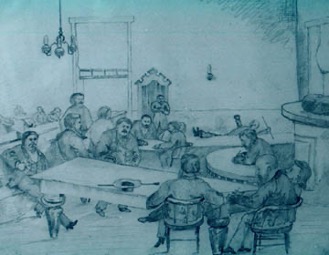
“Artist’s Depiction of the Helena Court House.” Source: Canadian Encyclopedia. Note how the artist has depicted the three men to the left (the accused). They are at ease, hat and cane are placed on the table and leaning back in the chairs. In the background a man waving a cane with his feet on the table. He is either tired or outraged. A clerk takes notes, but is the only representation of an official proceeding. The general atmosphere is mild distraction. Some sit with their backs to the proceedings. There is an audience, but no sign of a judge or police officer.
Of greater contemporary interest was the criminal career of the Lord Gordon Gordon. In 1873, the papers were full of his adventures. Canada refused to deliver the notorious fraud artist wanted by the US government. This led to a kidnapping attempt, which was foiled when the “Manitoba police” arrested the kidnappers. In response, the Minnesotan militia nearly invaded Manitoba under the direction of the governor. The affair was resolved only when Gordon shot himself in Headingly just west of Winnipeg in August 1874. This context may have impacted American coolness towards extradition in 1875.
Manitoba had only recently become a province, and the “Northwest Territory” had only just been created. Montana was recognized as a territory in 1864, and would not become a state until 1889. The boundary commission appointed in 1872 would only complete its work in 1876 and the reality of a division between the two states was relatively unclear. Residents on both sides of the border might be equally from eastern British North America or eastern United States. Migrants from Quebec were on both sides of the border.
Significantly, federal efforts by both governments to bring the men to justice for the killing at Cypress Hills were frustrated. An extradition trial in Helena and a murder trial in Winnipeg both failed to find anyone guilty of the killings of 30 human beings, not to mention the dispossession and terror struck into an entire community.
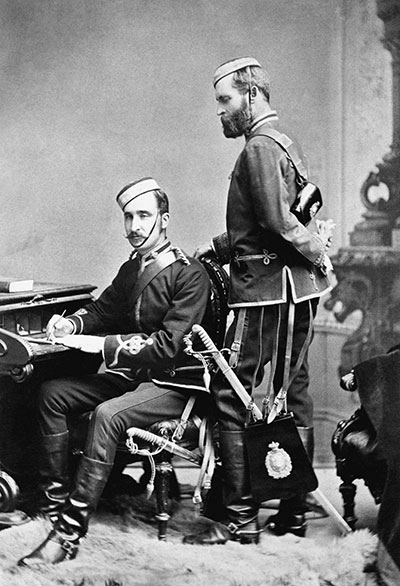
James Farquharson Macleod, NWMP, pictured here with Edmund Dalrymple Clark, 1870s. Source: Glenbow Archives NA-2206-1 via Dictionary of Canadian Biography. Macleod was arrested by American authorities when he attempted to extradite Montana residents to Canada on murder charges.
It is not clear when the Canadian government launched an extradition process, but in 1875 a police officer, Col. James Macleod, was given permission to proceed to the United States. With the support of the American military, five men were seized at Fort Benton and taken to Helena to face an extradition trial.[4] In response, one of the men sued Macleod for false imprisonment, and the North-West Mounted police officer was arrested and jailed. Macleod was released, but the American Commissioner, William E. Cullen, found that the witness provided by Canadian officials gave contradictory evidence and he dismissed the charges. He cited a court case from 1855 that restricted extradition to cases where “competent evidence” against the accused was provided.[5] Later that year, in October, the North-West Mounted Police arrested some of the same men in Canadian territory. They were taken to Winnipeg. There, following an intervention by the U.S. consul, they were found not guilty by the jury.
NWMP officer James MacLeod reflected in 1877 on the differences between the Canadian and American jurisdictions:
“I think the principal cause of the difficulties which are continually embroiling the American Government in trouble with the Indians is the way they are treated by the swarms of adventurers who have scattered themselves all over the Indian country in search of minerals before any treaty is made giving title. These men always look upon the Indians as their natural enemies and it is their rule to shoot at them if they approach after being warned off. I was actually asked the other day by an American who has settled here, if we had the same law here as on the other side and if he was justified in shooting any Indian who approached his camp after being warned not to advance.”[6]
That a police officer arrested by a foreign government should have a negative opinion on the exercise of law in the US is not surprising. But this opinion has shaped historical characterizations of the border. The famous case of Sitting Bull seeking refuge in the Northwest comes to mind.
But was Canada so exceptional in the introduction of law? To what degree was the “myth” of law and order only a myth?
It is worth highlighting that in 1875, this was the first effort to enforce the extradition treaty based upon the agreement signed in 1842 in the North-West. It would have been an innovation—though not an unwelcome one on both sides of the border.

Commissioner William E. Cullen. Source: Washington Biographies Project. Born in 1838 Ohio, he moved to Minnesota in 1860 to begin practicing law. He initially worked for a judge at the Supreme Court of Minnesota, and later opened his own practice.
The failure to bring the men to justice, rather than the killing itself, strengthened the sense of outrage. That outrage was useful in justifying the formation of the North-West Mounted Police. The formation of North-West Mounted Police force and the establishment of a base at Cypress Hills in the 1870s has given the impression that the federal police operating in the North-West Territories were responding to the events at Cypress Hills. This is not entirely accurate.[7] Yet, it is hard to deny the timing was politically useful. While the “myth of the Mountie” gradually developed over the years, it is also clear that early efforts to legitimize the exercise of federal policing in the Northwest Territories was also a public relations campaign. In the nineteenth century, when the federal police were still an innovation, framing police as a response to annexationist arguments based upon unsecure borders was useful for rallying political support.[8] In this way the NWMP and the extradition process (because of its failure) became a bare assertion of sovereignty by Canada against the United States of America.
Many historians have remarked that the NWMP police, and later the RCMP, have been wrapped in mythic nationalism. A key part of this has been the prevention of American lynch law on Canadian territory. This is based upon an exceptionalism which frames Canadian law and order as the foil to American violence—particularly against “Indian” peoples and communities. This exceptionalism is deeply looted in Canadian political culture since the Loyalist exodus and the War of 1812. It is hard to discount the impact of this Loyalist culture, because it did real political work. The Canadian anxiety over the border continues to be framed according to a desire to defend their unique northern culture of “law and order” against American frontier violence.
It is worth pausing to note that posterity has obscured our appreciation of the complex responses of American attitudes towards Canadian policing. To start, the genocidal commitment of the American media was not so different north of the border. There was a general commitment to security for settlers which involved Indian removal and elimination.
Certainly, some Americans were hostile to the idea that a foreign country might put limits on the frontier. James Macleod was seized by the American police, numerous newspapers defended the “Kit Carsons” who “cleaned out” the Assiniboine camp, and the American consul did interfere on behalf of the accused men during the second trial at Winnipeg. What might be forgotten, or has been overlooked, is that the American response was much more diverse.
I recall that Elizabeth Mancke once cautioned me that Canadian historians need to be more nuanced in their efforts to understand American perspectives on Canada—and the impact of that on understanding Canadian history. Torn as it was by the post-Civil War reconstruction and the shift toward a federal Indian policy based on “Peace” under President Ulysses Grant, the US public opinion was comprised of a range of attitudes towards the new Dominion and its efforts to secure the border.
A study of public opinion in Montana alone demonstrates this point. For example, following the first arrest and reports of public outrage and resistance, including the arrest of a NWMP officer, the Helena Weekly Herald (generally supportive of Grant and the Republican party) asked its readers “to refrain from continual and extended comment” on the matter: “International comity is a matter that we are as much interested to maintain as our British or Dominion neighbours.”[9] The paper further stated “It if were some barbarous nation that adjoined us on the north, there might be some reason to consider the propriety of trusting our citizens to be taken from our soil even for a trial, but surely British justice is not open to such a charge or supposition of barbarity or injustice.” On 29 July, following the release of Colonel MacLeod, the editor described the suit as motivated by a “barbarous spirit that despises all law…gratifying a blind revenge.”[10] It is not trivial to point out that the ideology of law did important work in the American conquest of the frontier as well.
The New North-West based in Deer Lodge, Montana, also reported “considerable feeling” over the arrests. Yet, it defended the policies of the Mounted Police who it explained were in pursuit of “amicable relations” with “Indians as well as defending the British soil from foreign invasion.”[11] Further, it suggested that the new police would prevent “marauding Indians who came down from British refuge” and provide Americans with a means of redress. At the same time as it defended the killers as “brave men” and the ridiculed the idea that they had intended to violate British authority, the paper insisted that the competence and authority of British beyond the border must be upheld.
To be clear, there was little sympathy for Indigenous peoples. During the second trial in Winnipeg, the Fort Benton Record, closer to the Canadian border and more critical of the US president’s “peace” policies, accused the Herald of supporting a Canadian “outrage” on Montana men.[12] The Bozeman Avant Courier also criticized the Republican administration. For the Avant Courier, the Cypress Hills attack was “just chastisement inflicted upon the savages,”[13] and, as the “unfortunate prisoners” were “in a British dungeon,” the paper hoped that Secretary of State Hamilton Fish would take action “vindicating the honor of the nation”.
It is worth pointing out that commentary, criticizing or supporting the extradition process, defended “civilization” and international law. At this time, a new appreciation of international law was reframing the significance of the border in matters of governance and security. It is hard to understand how radical it was that border control was important for security at the time. As the power of the Extradition Treaty was tested, postures about international law became relevant for both Canadian and American governments.
In 1875 Canada and the US were in the midst of negotiating a new extradition treaty. The US was also negotiating with other countries. US consul James Wickes used this delicate diplomatic situation as an argument for dismissing the court case in Winnipeg—his argument, correctly, was dismissed.
It is good to remember that the history of co-operation on border security is not straightforward. During another crisis, in 1885, North-West Mounted Police officer Sergeant Patterson was sent into Montana to observe and report on the Métis and Nehiyaw (Cree) refugees from the 1885 war. He was frustrated by the lack of co-operation that he received from American authorities.[14] Challenged by one Little Poplar about his authority in the US, Patterson found that he needed a pass from the American military, and he received little assistance. It is unclear why Canada did not attempt to have Gabriel Dumont and others implicated in the Resistance of 1885 extradited. But it is interesting that at least one US paper defended the progressive policies of the US military and their new adherence to international law: they did not simply deliver Indigenous people to British authorities without a formal extradition process.[15]
The border is rooted in a history of violence and dispossession of Indigenous territory. Current postures about the “arbitrary line” between Canada and the United States are not wrong; however it is ignorant to disregard the history that has made them meaningful. All borders are arbitrary because they are defined by political choices that have a particular context.
Max Hamon is Assistant Professor of History at the University of North British Columbia.
[1] Historical work has recovered some of their identities. Chief Manitupotis (Little Soldier) was killed after attempting to negotiate, for more details see Walter Hildebrandt and Brian Hubner, The Cypress Hills: The Land and Its People (Saskatoon: Purich Publishing, 1994).
[2] Historical identities during this period are notoriously difficult to pin down. The men may have claimed American legal identity even though they were from Quebec or Manitoba.
[3] The first report in the Manitoba Free Press is 23 August 1873. Alexander Campbell wrote of the news on August 13, 1873. See “Cypress Hills Massacre,” Glenbow Archives, M-4561-203-208.
[4] “Montana News,” New North-West, 25 June 1875, p. 2. Originally reported in the Helena Independent.
[5] Ex parte Kaine, 55 U.S. 103 (1852). The case is a complicated one, but from my reading it seems that through an application for habeas corpus the accused was able to challenge the extradition order; it was later cited in multiple extradition trials. For more details on Kaine in extradition trials see Bradley Miller, Borderline Crime: Fugitive Criminals and the Challenge of the Border, 1819-1914 (Toronto: Osgoode Society, 2016).
[6] Quoted in Doug Owram, Promise of Eden: The Canadian Expansionist Movement and the Idea of the West, 1856-1900 (Toronto: University of Toronto Press, 1980; reprint 1992), p. 139. Original from Annual Report of the North West Mounted Police, 1877, p. 46
[7] A chronology clearly shows that the impetus for creating a police force had already been planned. The Canadian government received letters applying for police commissions well before the events of June 1873. See Phillip Goldring, “Appendix C. Notes on the Cypress Hills Massacre and the Formation of the North-West Mounted Police;” The First Contingent: The North-West Mounted Police, 1873-74, Canadian Historic Sites: Occasional Papers in Archaeology and History, no. 21. Parks Canada, 1979.
[8] I have seen no evidence that it was compared with the Carolina Affair; however the idea that American’s might use Canada’s inability to secure the territory as an argument for annexation might have been in the minds of administrators.
[9] “An International Affair,” Helena Weekly Herald, 1 July 1875, p. 2. All newspapers accessed through Chronicling America: Historic American Newspapers. URL: https://chroniclingamerica.loc.gov/.
[10] “Discharge of Col. MacLeod,” Helena Weekly Herald, 29 July 1875, p. 4.
[11] “The Extradition Case,” New North-West, 12 July 1875, p.2.
[12] “The Canadian Herald,” Fort Benton Record, 30 October 1875, p. 1.
[13] “Americans in a British Prison,” Bozeman Avant Courier, 23 October 1875, p. 2.
[14] Letter from Patterson to Commissioner, Maple Creek, 3 October 1885. RG 10 vol 3722 F#24125. Little Poplar was murdered shortly after this encounter. Recently Eden Fineday identified the remains of her great Grandfather, “Little Poplar” in the Smithsonian Museum; see “I found my Ancestor’s Remains at the Smithsonian, The Tyee, 8 Mar 2024, https://thetyee.ca/Opinion/2024/03/08/I-Found-My-Ancestor-Remains-Smithsonian/.
[15] “This lax principle has given way it seems to more enlightened ideas. The commanding officer at Fort Assiniboine has received a telegram from the war department in accordance with the wishes of the interior department not to transport these Indians across the border.” “The Captured Crees,” The River Press, 30 December 1885, p. 5.
Featured image: Site of the Cypress Hills Massacre, courtesy of Wikipedia.

